
Overview
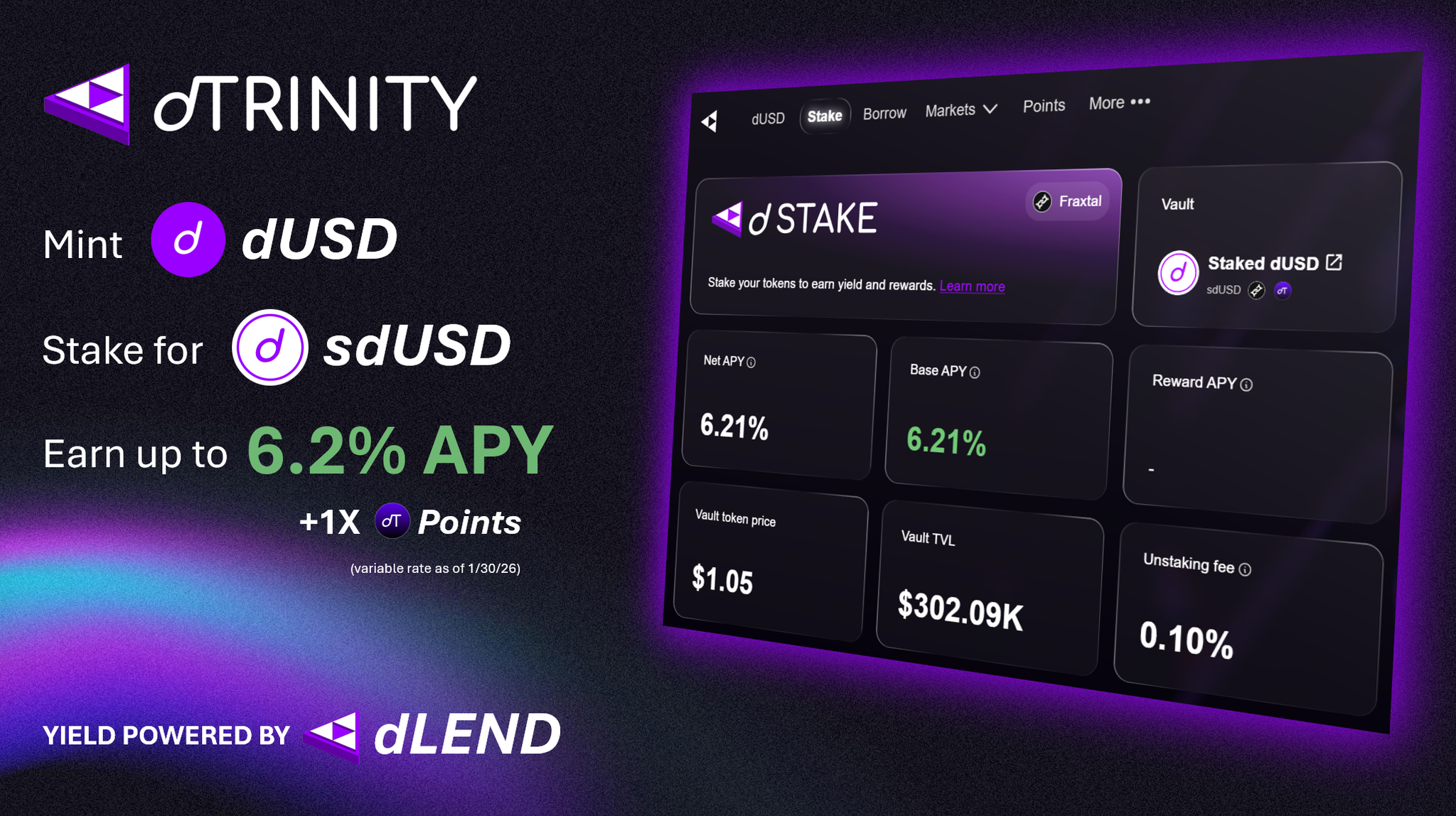
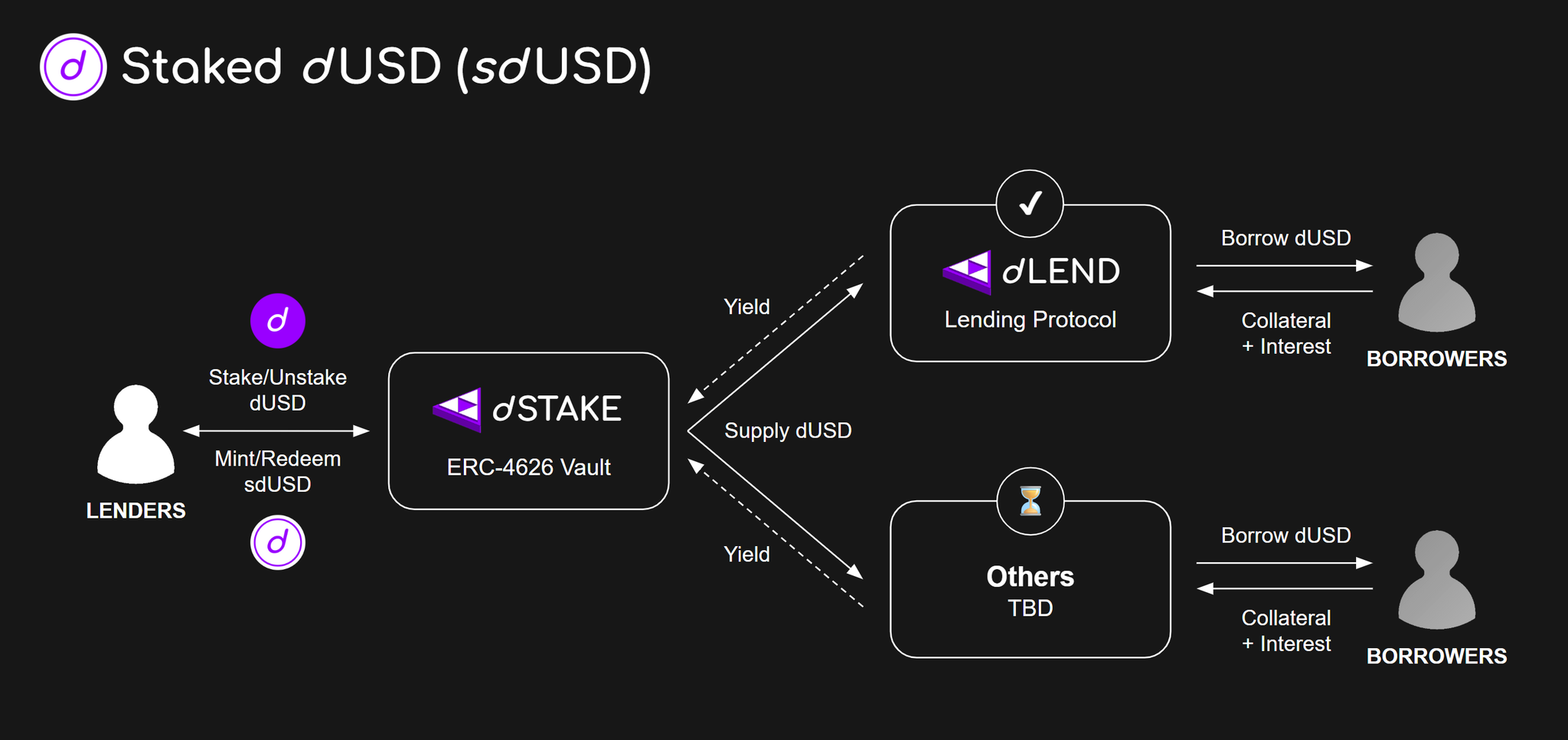
dSTAKE is a composable ERC-4626 vault that allows users to stake  dUSD and receive sdUSD receipt tokens. dUSD in the vault is automatically supplied into
  dLEND, earning yield which accrues to the vault’s NAV (net asset value). The receipt token also unlocks access to secondary market liquidity. Holders can unstake or sell sdUSD on DEXs to recoup liquidity and realize the embedded yield as its unit NAV and market price appreciate over time. Therefore, sdUSD is considered a yieldcoin backed by dLEND dUSD deposits, and sdUSD holders are effectively dUSD lenders.
dUSD and receive sdUSD receipt tokens. dUSD in the vault is automatically supplied into dLEND, earning yield which accrues to the vault’s NAV (net asset value). The receipt token also unlocks access to secondary market liquidity. Holders can unstake or sell sdUSD on DEXs to recoup liquidity and realize the embedded yield as its unit NAV and market price appreciate over time. Therefore, sdUSD is considered a yieldcoin backed by dLEND dUSD deposits, and sdUSD holders are effectively dUSD lenders.dSTAKE and sdUSD deployments are chain-isolated by design to mitigate network-specific risks, similar to dUSD’s architecture. This also means sdUSD is non-fungible across chains.
Below are the addresses for sdUSD on each supported network:
Name | Token Contract | Vault Contract |
Ethereum sdUSD | ||
Fraxtal sdUSD |
Staking & Unstaking
Staking/unstaking is permissionless and atomic. The vault’s staking capacity is determined by dUSD’s supply cap in dLEND. On the other hand, unstaking capacity is based on unutilized liquidity that’s available for withdrawal from dLEND. When there is insufficient liquidity in dLEND for users to unstake, utilization and Borrow APY for dUSD will naturally spike. This encourages borrowers to repay their loans and restore liquidity, at which point the vault can resume processing unstaking requests.
By allowing users to stake/unstake dUSD seamlessly without cool-down periods, the vault enables arbitrageurs to market-make sdUSD more efficiently, improving both liquidity and price stability of sdUSD relative to its unit NAV.
dSTAKE has no staking fees. Unstaking incurs up to 10 bps in fees, which are retained by the vault for all remaining sdUSD holders.
User Benefits
sdUSD simplifies user experience for dUSD lenders while providing them with a liquid and composable yieldcoin that can interact with other DeFi Partners, allowing users to stack multiple layers of utility on the same underlying capital. For example:
- LPs can provide liquidity for sdUSD on
Curve to earn trading fees and rewards on top of native yield from dLEND.
- Loopers can supply sdUSD into external lending protocols as collateral to borrow other stablecoins and acquire more sdUSD, capturing potential carry trade opportunities.
- Yield traders and LPs can supply sdUSD into interest rate marketplaces like Pendle to trade PT/YT derivatives or provide liquidity and earn fees/rewards.
- Other protocols can integrate sdUSD into their ecosystems, providing users access to non-volatile, yield-bearing liquidity backed by secured credit.
Similar to dUSD lenders, sdUSD holders also earn  dT Points. sdUSD LPs, in particular, earn the most points for helping the protocol expand its reserves, credit supply, and market liquidity.
dT Points. sdUSD LPs, in particular, earn the most points for helping the protocol expand its reserves, credit supply, and market liquidity.For user instructions and current opportunities, please refer to User Guide.
Vault Strategy
Lending Markets
dLEND is the first lending protocol that’s integrated by dSTAKE, where dUSD is supplied to earn yield. In the future, dUSD vaults and markets in other strategic lending protocols (e.g., Morpho) may also be considered for dSTAKE integrations, subject to risk assessments and protocol governance.
Yield Generation
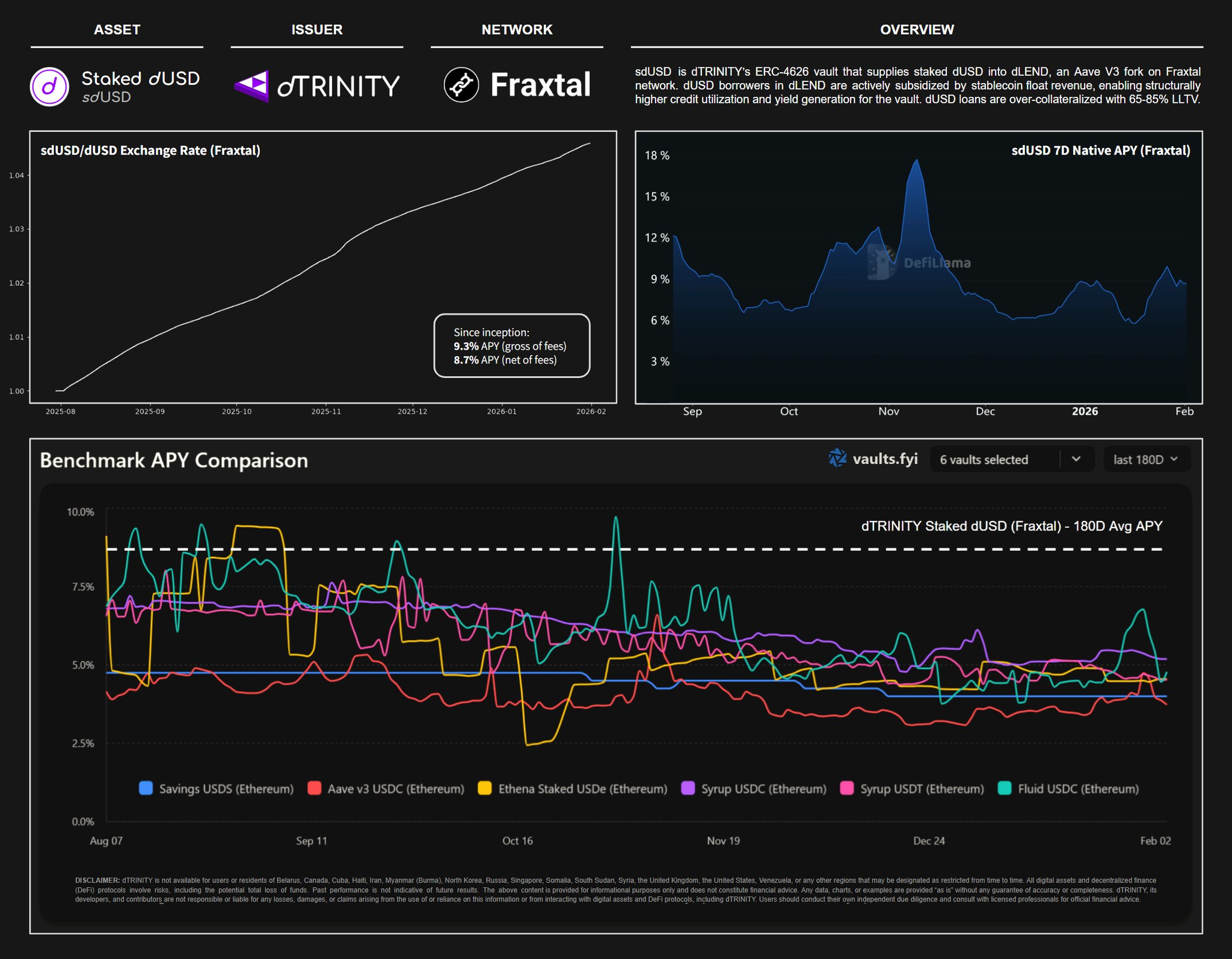
sdUSD’s Native APY is the same as dUSD’s Supply APY, which is determined by dLEND’s dynamic interest rate model, where higher credit utilization increases the Supply APY, and vice versa. Protocol governance may adjust dLEND’s interest rate model over time to align dUSD’s Net Borrow APY (after rebates) with market rates (e.g., Aave USDC) at optimal utilization. This, in turn, enables dUSD lenders/sdUSD holders to earn a higher Supply APY/Native APY than market rates.
Thanks to dUSD borrower subsidies, sdUSD is expected to generate above-market average yield from subsidized credit demand and structurally higher utilization in dLEND.
Since its inception on Fraxtal, sdUSD has generated an average APY of 8.7% (net of fees, as of January 31, 2026).
Risk Management
In addition to dUSD’s reserve backing, the health of dUSD deposits in dLEND is critical to dSTAKE’s vault integrity. If dLEND incurs bad debt, dUSD lenders and sdUSD holders could be exposed to potential losses. Additionally, since dUSD borrowers on dLEND are actively subsidized, they may naturally take on above-average risk. Therefore, dTRINITY adopts conservative protocol parameters and policies that prioritize safety for dUSD lenders and sdUSD holders over borrower flexibility.
For more details, please refer to dLEND.
dLEND.