
Overview
dTRINITY draws its name and inspiration from Frax Finance’s “DeFi Trinity“ framework, structuring core protocol components around three distinct but vertically-integrated functions: stablecoin, credit, and liquidity.
Stablecoin
A non-volatile and fungible unit of account, backed 1:1 by collateral reserves. It is the protocol’s unified medium of exchange, credit, and liquidity.
Lending Markets
Decentralized lending and borrowing markets that allow onchain credit formation and yield opportunities for the stablecoin to emerge.
Liquidity Pools
Trading pairs on decentralized exchanges (DEXs) that enable onchain swaps, price discovery, arbitrage, and secondary market liquidity for the stablecoin.
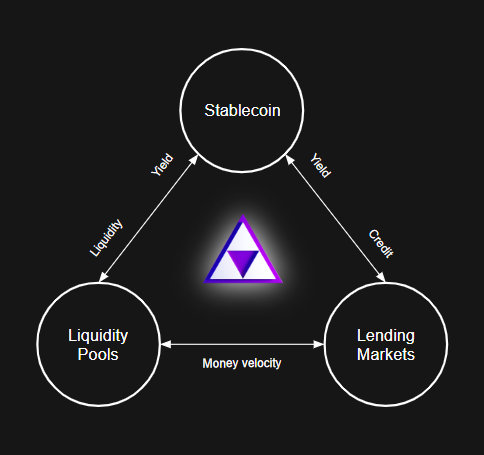

“There is no difference between currency, credit, and liquidity. They are all different parts of the same thing.” ~Sam Kazemian, Co-founder of Frax Finance.
Natural Progression
Reserves collateralize stablecoins → Stablecoins facilitate credit and liquidity → Credit and liquidity increase money velocity → Money velocity drives yields → Yields attract more capital and reserves → Repeat ♾️
Horizontal Expansions
The vertically-integrated DeFi Trinity framework can also be expanded horizontally across multiple blockchain networks, enabling chain-native deployments that share a common system design.