
What is dTRINITY?
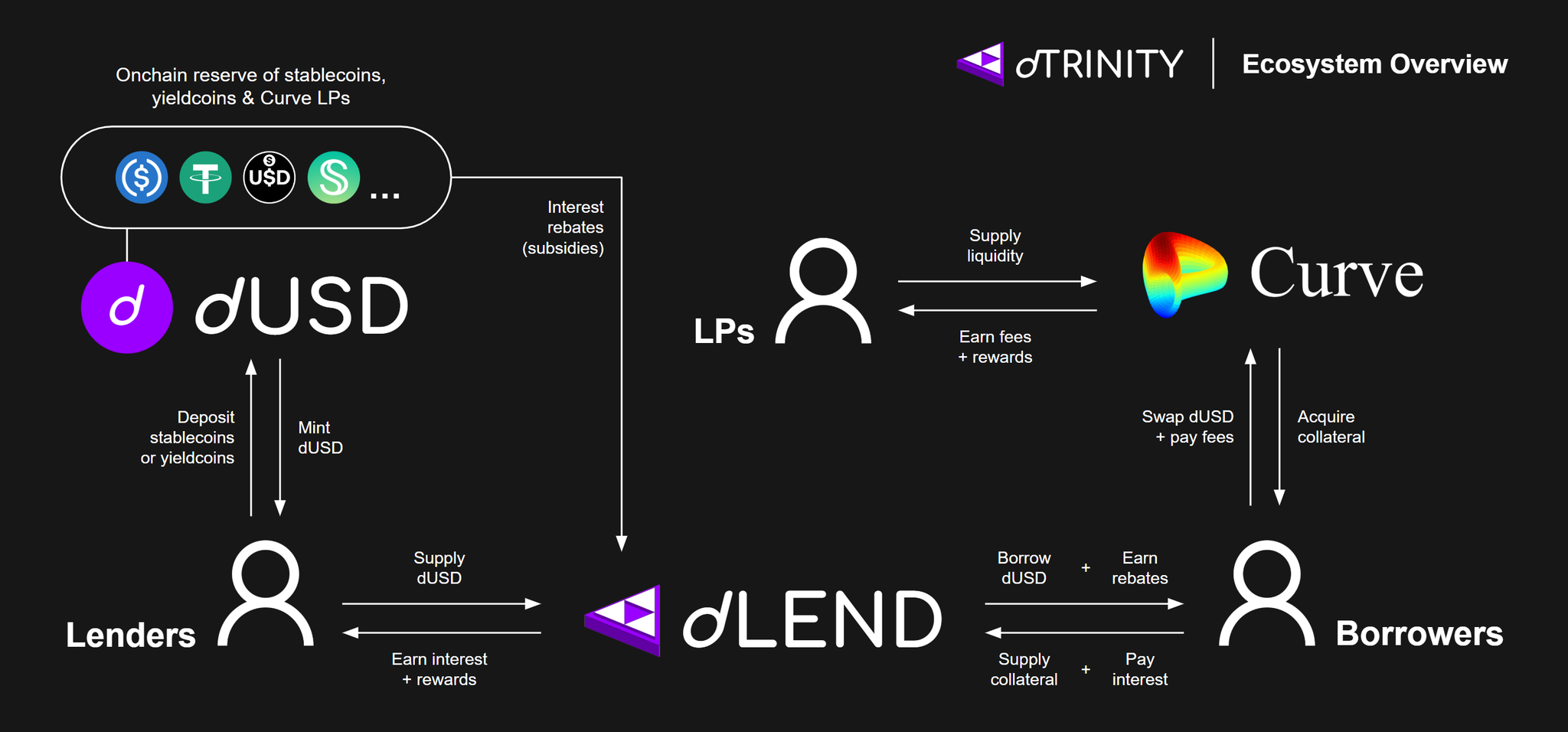
dTRINITY (short for "DeFi Trinity") is the world's first subsidized stablecoin protocol, a new DeFi primitive designed to stimulate onchain credit markets. The protocol consists of three core components: a decentralized stablecoin, lending markets, and liquidity pools.
dTRINITY offers float revenue-funded interest rebates to borrowers of its native stablecoin, dUSD, thereby reducing their effective borrowing rates. Unlike traditional stablecoin models that reward passive holders, stakers, or lenders on the supply side, dTRINITY flips the script by actively subsidizing dUSD borrowers on the demand side.
Why dTRINITY?
Subsidies unlock structurally lower costs for borrowers as well as higher yields for lenders and LPs through greater credit demand and money velocity.
Like Yin and Yang, dTRINITY introduces the long-missing counterpart to traditional supply-centric models in DeFi, completing the feedback loop between stablecoins, credit, and liquidity.
For more details, please refer to Problems & Solution.
How does dTRINITY work?
Core Components
dUSD, a decentralized stablecoin backed by yield-bearing reserves.
dLEND, an Aave V3 fork that offers dUSD loans with interest rebates.
Curve liquidity pools for dUSD and other protocol-issued assets.
Other Components
sdUSD, a tradable lending vault / yieldcoin version of dUSD.
dT Points, a points program that rewards dUSD lenders, stakers, and LPs.
dLST 🚧, the first subsidized liquid-staking tokens for ETH and BTC.
TRIN 🚧, the future protocol governance token based on veTokenomics.
For more details, please refer to  Protocol Components.
Protocol Components.DeFi Flywheel
1. Lenders and LPs mint dUSD, introducing new reserves, credit supply, and liquidity into the ecosystem.
2. Float revenue from the reserve funds borrower subsidies, reducing net costs.
3. Borrowers supply collateral to borrow dUSD, paying gross interest while earning rebates.
4. Credit demand and utilization start rising toward a higher equilibrium.
5. Eventually, borrowers pay above-market gross interest rates, but net borrowing costs after rebates remain near market levels.
6. Lenders now earn above-market yields, driven by subsidized credit demand.
7. Borrowers redeem or sell dUSD on DEXs to access liquidity.
8. When borrowers unwind, they mint or buy back dUSD to repay debt.
9. LPs now earn higher trading fees thanks to increased trading volume and money velocity.
10. Improved yields and fee earnings attract more TVL (total value locked) into the ecosystem.
11. Repeat ☯️
For more details, please refer to Stablecoinomics 101.
Who does dTRINITY benefit?
- dUSD borrowers benefit from lower net interest rates and improved capital efficiency. Yield loopers who borrow dUSD also benefit from subsidized leverage, which may increase carry potential.
- dUSD lenders, including stakers (sdUSD holders), benefit from structurally higher utilization and yields, driven by subsidized credit demand.
- dUSD and sdUSD LPs benefit from increased trading volume and fee generation, boosted by subsidy-driven money velocity.
For user instructions and current opportunities, please refer to the User Guide.
Where is dTRINITY deployed?
- dTRINITY is live on Ethereum, Fraxtal, and Katana. Additional chain expansion plans will be announced in the future.
- External markets for protocol-issued assets are available through strategic ecosystem integrations such as Curve Finance, Sushi Swap, and Morpho.
For more details, please refer to  Network Support and DeFi Partners.
Network Support and DeFi Partners.When is the TGE?
The TGE (token generation event) for TRIN is currently targeted for the second half of 2026. Prior to the TGE, early liquidity contributors are rewarded through the points program. At the TGE, all eligible points will be claimable for TRIN tokens. Additional details will be released closer to the TGE.